
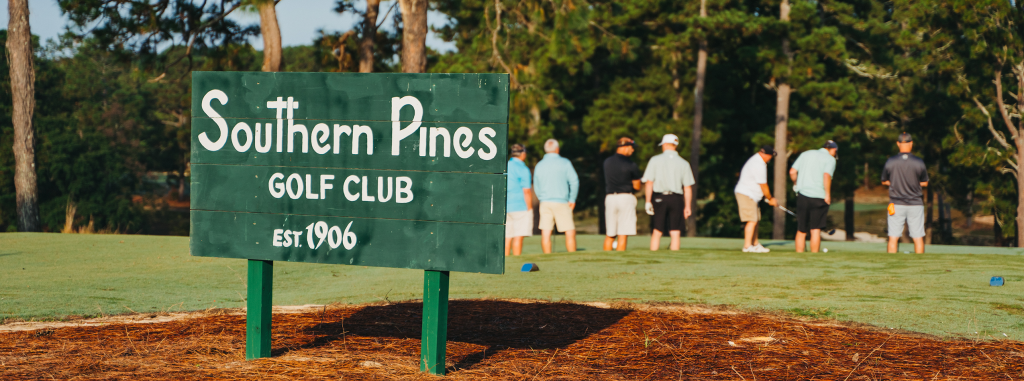
Fully Restored and Open for Play
Southern Pines Golf Club, a vintage Donald Ross-designed course dating to the early 1900s, is now under management of the company that owns and operates Pine Needles and Mid Pines in Southern Pines, North Carolina. The course has undergone an 18-month improvement plan that included design tweaks from architect Kyle Franz, who has supervised restorations at Mid Pines (2013) and Pine Needles (2018.) The restoration started with tree removal and bunker work in December 2020, before moving on to work on the greens, cart paths, and other areas of the course to restore Donald Ross’ original design.
On every hole of the course, we widened the fairways to make them more inviting for the beginning level players, but also allow more advanced players to strategize. Removing the maintained rough around the greens and making it all clean fairway height will encourage players to be creative and have more fun. To improve the course’s irrigation, we installed all new piping around the greens with new wiring in the fairways, and tackled a great deal of bunkers. Our goal was to make the golf course feel as much like a Ross original, staying true to the well preserved routing and trying to remove the superfluous elements that have been added over the decades.
There are currently no plans for the “Little 9” at this time, as management’s focus is on perfecting every detail on the main course.
The Lost Hole
Southern Pines is unique among most American courses in that the ninth hole does not return to the clubhouse. Franz had access to aerial photos of the course dating to the early 1950s that shows a par-three hole positioned to the left of the fourth green and and connecting with the 15th tee. That hole would have allowed golfers to play one through four, this par-three and finish a nine-hole round with 15 through 18. The par-three was abandoned at some point in the mid-1900s, but we are building a new par-three hole to replace “the lost hole” from Donald Ross’s original design.